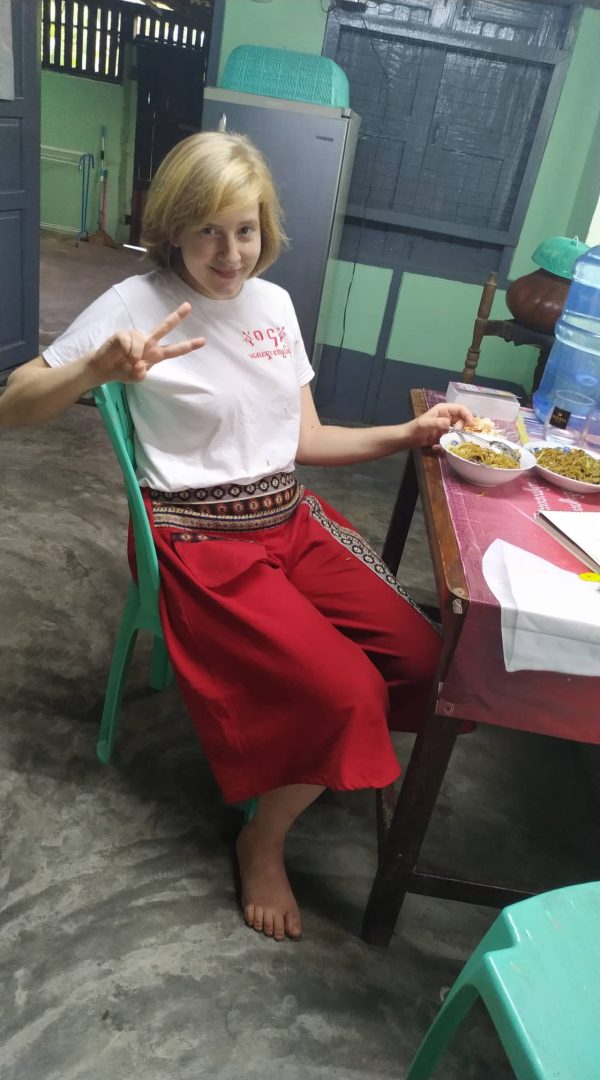
This riveting tale is based on numerous events taken from the life of Sarah Bauer: a Myanmar Peace Corps Volunteer.
Not so long ago, in a country called Myanmar, Sarah was enjoying one of her few opportunities to sleep in on the weekend. However, at 7:30am her phone rang and she remembered, “That’s right, I can never sleep in on the weekends.” Her lovely aphwa (grandma, next door neighbor) said, with so much excitement, one of the very few phrases she knows in English and tells Sarah nearly every day.
“Sarah! Open the door!”
“Ok, I’m coming.”
Sarah throws on one of her two nightdresses that she wears around the house every day and opens the door to see one of the many teachers whose name she still doesn’t remember. She feels horrible about this, but each name is like a new vocab word. She hopes she won’t quiz her like so many do. Sarah unlocks her gate and lets her in. She has a food carrier that doesn’t go unnoticed by Sarah. They proceed to have a conversation in Myanmar.
“Hello Sarah!”
“Hello!”
“How are you?”
“I’m good. How are you?”
“I’m good. Are you happy in Myanmar?”
“Yes, I am happy in Myanmar.”
“Do you need anything?”
“No I don’t need anything, thank you.”
“Have you eaten yet?”
“No, I just woke up. I will cook later.”
“What will you cook?”
“Chicken curry with rice.”
“You like chicken curry?”
“Yes I do.”
“Can you cook rice?”
“Yes, I can cook rice,”
“What else can you cook?”
“I can cook chicken, pork, egg curry, and other American foods.”
“By yourself?”
“Yes, by myself.”
“Really?”
“Really.”
(Myanmar equivalent of “Woah” or “No way”)
“Yeah, I cook in America too.”
“Do you eat rice in America?”
“Sometimes, but not every day”
“Really?”
“Really.”
“Well what do you eat in America?”
“We eat scrambled eggs, pizza, spaghetti, tacos…”
The teacher has a confused expression because none of these foods are eaten in Myanmar. Sarah continues,
“Myanmar food and American food are very different.”
She nods. The teacher then gestures at the food carrier “Will you eat it?”
“Oh yes I will, thank you!”
The teacher proceeds to walk into Sarah’s kitchen and grab some plates and bowls from her shelf. She pours Mohinga into a bowl and puts some chives, cilantro, tomatoes, and crunchy bean fritters on a plate for her to put in the Mohinga. Mohinga is a very traditional Myanmar dish that the country is very proud of. It has thin noodles and a fish broth that surprisingly doesn’t taste that fishy. The teacher sits down at the table next to Sarah but has no food in front of her.
“Do you want to eat any?” Sarah asks, knowing the answer.
“Oh no, I’ve already eaten.”
Sarah starts eating the Mohinga and the teacher smiles at her while she’s eating. Sarah nods to show she likes it and adds in a few “Kaun deh’s” (It’s good) to assure her even more. After the silence is long enough and the teacher has decided she’s seen enough of Sarah eating, she tries out some of her English.
“Do you remember your family?” (Remember and miss mean the same thing in Myanmar, so this is a common mistake).
“Yes I remember them.” Sarah is always tempted to answer “No, I completely forgot who they were!” but knows that nobody would understand the joke except for her.
“You like Mohinga?”
“Yes, I like Mohinga.”
She nods, pleased with the answer. “Sarah, what do you need?” (at first Sarah needed a lot of basic items in her house that people helped her attain, but by this point she’s fairly settled).
“I don’t need anything right now, thank you so much.”
The conversation shifts back to Myanmar.
“Ok ok. I will go now, ok?”
“Ok, thank you, see you later!”
“I’ll see you later, no?”
“Yes, see you later!”
The teacher waves goodbye as she drives off on her motorcycle. Sarah is thankful for the immense amount of hospitality the people of Myanmar have, even if it means she never sleeps in anymore. She also will remember that teacher’s name one day.
One day.



 Meditations on Myanmar